
Checking Criminal History in Madison County
No one database holds the full Madison County record. Begin with the detail you want. A filed charge, court date, judgment, or sentence belongs to the Clerk of Superior Court. The arresting agency keeps its own incident report. Madison County detention staff create the booking file, while the North Carolina State Bureau of Investigation links qualifying fingerprinted arrests to dispositions it receives. A warrant can require both court and sheriff confirmation because the public docket is not a guaranteed live warrant list.
Use a full legal name, spelling variants, an approximate event date, and any case or incident number. Check each same-name result against the county, dates, charges, and case number. A person reviewing an official file should not treat a name match as an identity match.
- Search North Carolina eCourts Portal by name or case number, then filter to Madison County and criminal matters.
- Confirm the result through the case number, dates, charge, and case status.
- Ask the temporary clerk for a public file, terminal search, copy, or certified Madison County search.
- Request the incident or arrest report from the sheriff or town police agency that created it.
- Use SBI Right to Review for your own fingerprint record, or NCDAC search for state custody and supervision.
The official Madison County home page posts active facility notices and public service updates. Its current presentation is shown below.
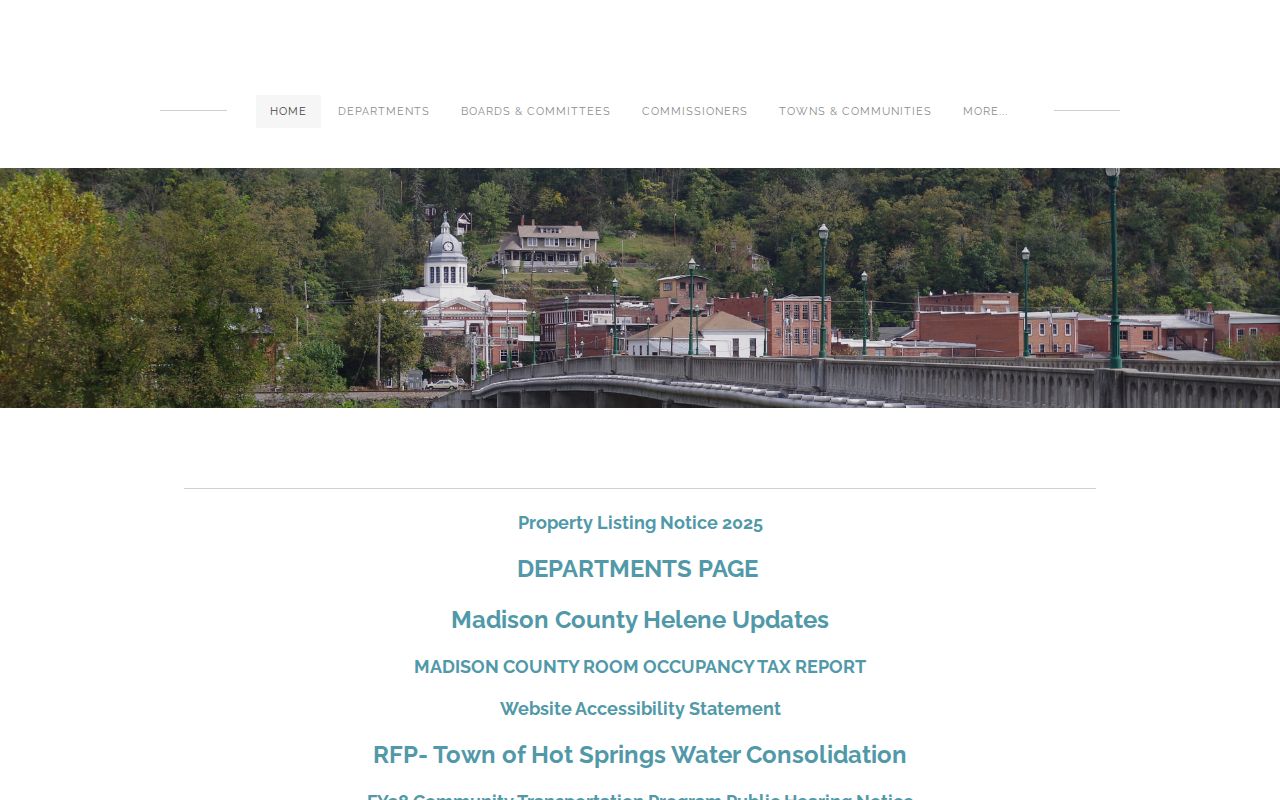
That county source is worth checking before travel because records offices and public buildings have changed location.
Four Madison County Criminal Record Custodians
Madison County criminal records split among the sheriff, three town police departments, the clerk, and state agencies. The office that created a file is usually the right first stop. The sheriff holds sheriff incident reports and county booking material. Mars Hill, Marshall, and Hot Springs keep reports their officers made. The clerk maintains District and Superior Court files. SBI maintains the fingerprint-based state history, while NCDAC maintains state prison and community-supervision data.
This split matters after a town arrest. For example, Mars Hill Police may hold the incident narrative, Madison County detention may hold the intake record, and the clerk may hold the later criminal case. Asking one custodian for all three can produce a partial reply, not proof that the other records do not exist.
| Question | Start here | Record obtained |
|---|---|---|
| What did an officer report? | Arresting sheriff or town police agency | Incident or arrest report |
| Was the person booked locally? | Madison County Sheriff | Custody or booking information |
| What happened to the charge? | Clerk and eCourts | Case docket, disposition, judgment |
| What is on my state record? | SBI Right to Review | Fingerprint-linked North Carolina history |
Note: A police report, booking entry, court file, and SBI history are separate records even when they concern the same event.
North Carolina Official Background Checks
North Carolina offers several official products, each with a different scope. Anyone may order a certified, name-based search of Madison County court records from the clerk. It costs $25 and uses Form AOC-CR-314. A free public terminal search at a clerk's office can cover selected counties or the state, but the result is not certified. eCourts supplies case information, yet the Judicial Branch directs people who need a background check to the clerk.
The SBI has no open, pay-per-name public search. Its Right to Review lets a person inspect their own North Carolina fingerprint history. The request needs a complete FD-258 fingerprint card, the current form, and a $14 certified check or money order. The separate FBI Identity History Summary costs $18 and covers the record subject's national FBI identity history.
| Official product | Scope | Fee and route |
|---|---|---|
| Clerk certified search | Madison County court records by name | $25, by mail or in person |
| Clerk public terminal | Statewide or selected county court data | Free search; printing may cost |
| SBI Right to Review | Subject's fingerprint-based North Carolina history | $14 per copy, by mail |
| FBI Identity History Summary | Subject's national FBI history | $18 FBI fee |
The North Carolina Judicial Branch background-check page explains the certified and terminal choices.
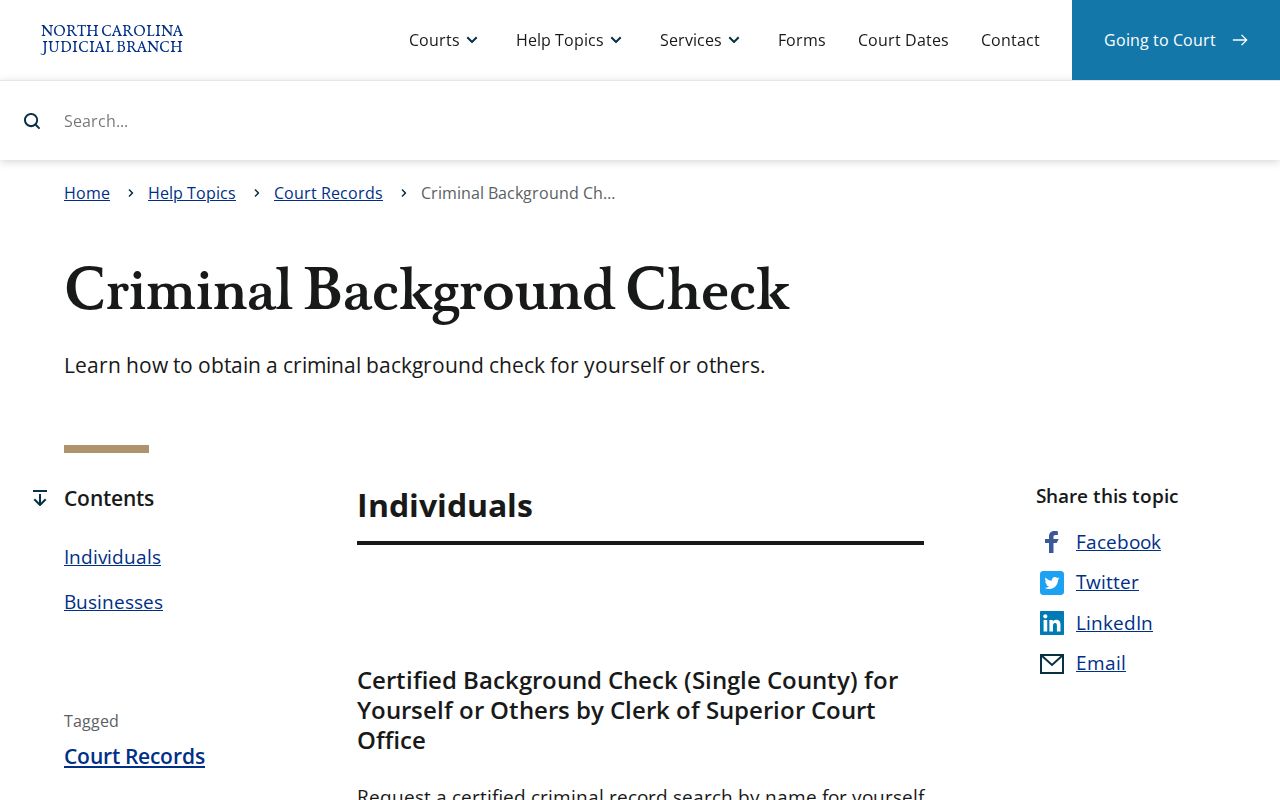
The image reinforces the key scope point: a certified clerk result is a county court search, not a fingerprint repository report.
Madison County Criminal Records Moved
The historic courthouse at 2 North Main Street in Marshall is closed until further notice. Madison County clerk counters, public terminals, paper criminal files, and both Superior and District Court sessions now operate at the Madison County Extension Office, 258 Carolina Lane. Mail still goes to Madison County Courthouse, P.O. Box 217, Marshall, NC 28753. The clerk's main number is (828) 649-2200.
Two official hour statements differ. The temporary-operations notice says 8:00 a.m. to 5:00 p.m., while the standard location panel says Monday through Friday, 8:30 a.m. to 5:00 p.m. Call before driving. This is especially important in a mountainous county where the mean trip to work is more than half an hour and old search results may still point to Main Street. The official temporary courthouse advisory shows the operative address and closure status.
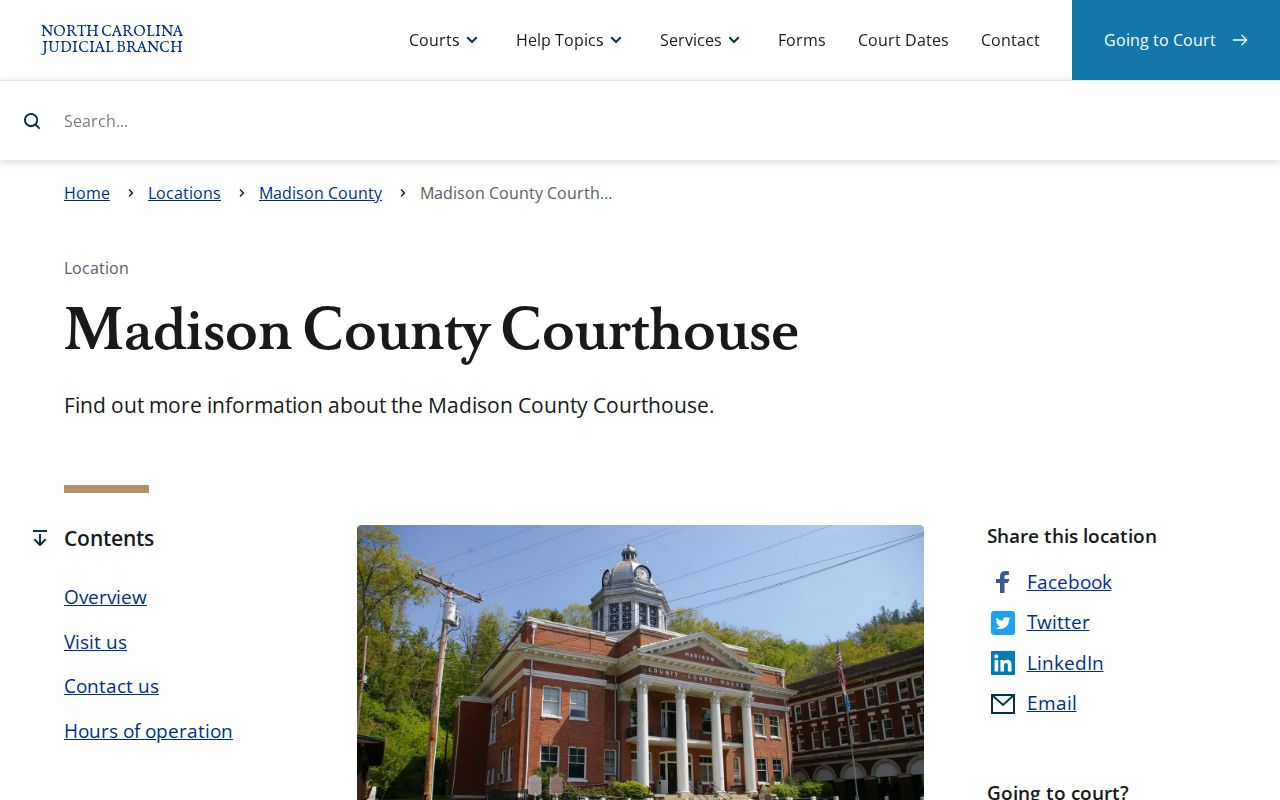
That live notice should control over an older directory entry when planning a clerk visit or court appearance.
Note: Verify the Madison County clerk location and opening time by phone before any time-sensitive filing, search, or hearing.
Criminal Record Types
A criminal record is not one fixed document. Madison County agencies build records at each stage, and each file answers a different question. The report describes an allegation and the officer's work. The jail file records intake and release. The court file tracks legal action. SBI links fingerprinted arrest cycles with reported outcomes. NCDAC records state prison or supervision status.
Choosing the wrong record can change the apparent result. A booking charge may be screened or amended before filing. A court dismissal may remain in a public file until an expunction applies. A missing SBI entry can reflect the lack of a qualifying fingerprint card or an unmatched disposition.
- Incident and arrest report: The originating law-enforcement agency holds the event facts and investigative narrative.
- Booking record: Madison County detention records intake, charge, bond, custody, and release data.
- Court case file: The clerk holds pleadings, hearings, orders, dispositions, judgments, and costs.
- SBI history: The state record ties qualifying fingerprinted arrests to dispositions received by SBI.
- Corrections record: NCDAC reports state imprisonment, probation, parole, and post-release supervision data.
- Registry listing: SBI displays statutory sex-offender registry information entered and checked by sheriffs.
Madison County has no complete official public warrant database. For a suspected warrant or order for arrest, use the magistrate at (828) 649-2442 for judicial-process routing, the sheriff for enforcement or custody, and the clerk or eCourts for the linked public case. Portal is not guaranteed to show live warrant status, and sealed or juvenile process will not appear like an ordinary docket.
For a deeper docket review, the Madison County criminal court case records explain how charges, counts, and outcomes appear.
Madison County Criminal Booking Fallbacks
No official public Madison County inmate roster, daily arrest log, or booking gallery was located. For recent custody, call the Madison County Sheriff at (828) 649-2721. Detention staff duties include giving nonconfidential information to the public, attorneys, and bond personnel. A phone call can confirm basic custody procedure, but it is not the sheriff's formal record-request channel.
When a copy or a fuller releasable booking record is needed, submit the sheriff's written form. Include the person's name, date and place, arresting agency, and known incident, booking, or case number. Search eCourts for a later Madison County filing, but allow time between intake and court entry. If the person has moved into state prison or state supervision, switch to NCDAC rather than treating its database as a county jail list.
The Madison County Sheriff page provides the current public-safety complex contact.
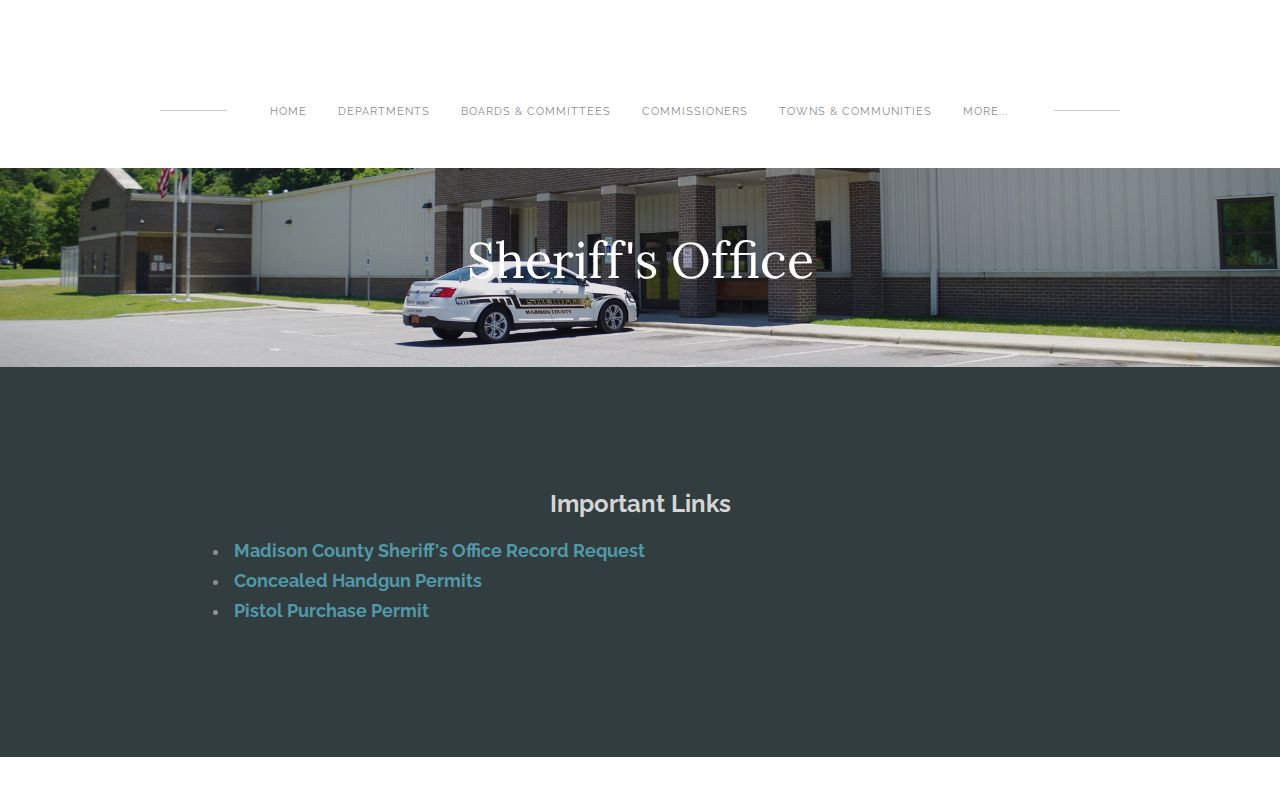
The official office page supports the phone-and-written-request fallback without inventing a public booking portal.
Inside a Madison County Criminal Record
Read each record in its own time frame. A booking record is an early custody snapshot. A Madison County court file follows the charge through hearings and disposition. An SBI record is a broad identity-linked history, but it contains less narrative and fewer pleadings than the court or police file.
| Name and identifiers | Legal name, aliases, party role, and identifying details allowed in that public system. |
|---|---|
| Arrest and booking | Agency, intake date, booking identifier, initial charge, bond, and custody or release status. |
| Charges and statutes | Each count, offense description, class, statute, and filing or offense date where entered. |
| Disposition | The outcome of each count, such as conviction, dismissal, or not guilty. |
| Sentence | Judgment, custody or community terms, restitution, costs, and other public obligations. |
| Supervision status | NCDAC prison, probation, parole, or post-release data when the person is in its system. |
Several terms need care. A disposition is the legal outcome of one charge. An order for arrest is North Carolina process directing an arrest, often after failure to appear or comply. Expunction is statutory removal from ordinary public access, not a mere notation that a charge was dismissed.
North Carolina labels felonies from Class A through Class I and misdemeanors as Class A1, 1, 2, or 3. A class does not supply one fixed sentence. Felony punishment also depends on prior-record level and the structured-sentencing range; misdemeanor punishment depends on class and prior convictions. The booking class is still an allegation. Amendments, findings, and the final Madison County judgment control the legal result.
Reading Madison County Criminal Cases Online
North Carolina eCourts Portal became statewide in all 100 counties in October 2025. Use Smart Search for a person, business, or case number, then narrow to Madison County and criminal cases. Official help also identifies attorney and citation searches. Common names require extra care. Compare the case number, county, filed date, offense date, and charge before deciding that a result belongs to the person sought.
The Madison County court hub connects court users with calendars, forms, services, and eCourts access.
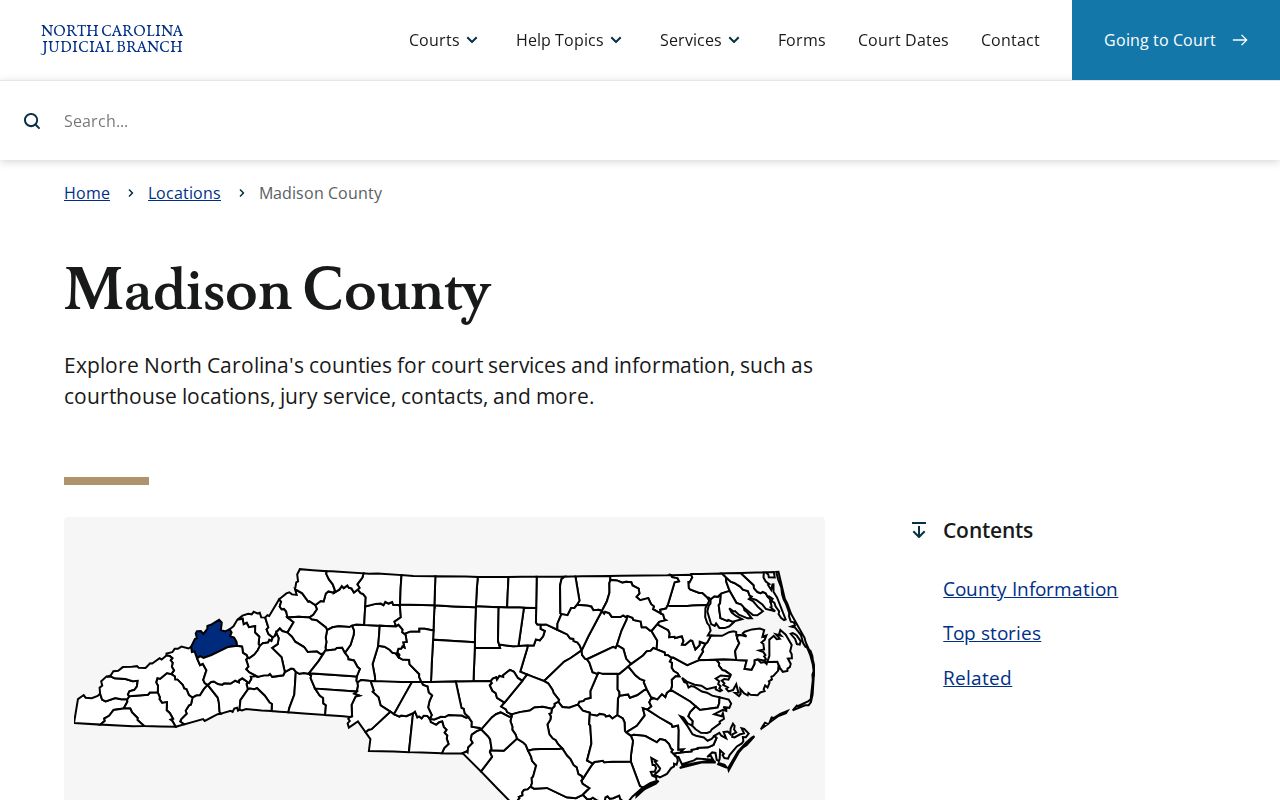
The hub is the official route when the Portal shows an event but the underlying Madison County document is not online.
| Portal control | Use | Search caution |
|---|---|---|
| Search Criteria | Name or case number; help also supports attorney and citation routes | Check spelling variants and do not merge names |
| County | Select Madison for a county review | A broad search can mix courts statewide |
| Case category | Narrow to criminal where available | Civil and other case types may share names |
| Filed date range | Limit results to a known event period | Filing may follow arrest or citation |
| Advanced filters | Reduce the result set | A missing public hit is not proof no file exists |
Note: “Disposed” means the court entered an outcome; it does not mean every charge ended in a conviction.
Public Access Laws in North Carolina
North Carolina Public Records Law starts with broad access, but the kind of record controls what can be released. Madison County custodians must permit inspection and copies at reasonable times unless another law protects the material. Basic arrest facts have a different status from investigative narratives, witness statements, intelligence, and active techniques. A custodian can redact protected personal details and is not required to create a new report or compilation.
Court records are generally open through the clerk unless sealed or made confidential. Law-enforcement recordings use a special disclosure and release process. Juvenile files, victim and minor information, Social Security numbers, financial account data, sealed matters, and expunged cases do not appear like ordinary public criminal records.
Key North Carolina laws:
G.S. 132-1 and 132-6 define public records and require access at reasonable times, subject to exemptions.
G.S. 132-1.4 separates basic arrest information from protected criminal-investigation and intelligence records.
G.S. 132-1.4A creates a distinct process for body-camera, dashboard, and other law-enforcement recordings.
G.S. 7A-109 keeps clerk records open unless another law seals or protects them.
G.S. 15A-145.5 sets eligibility and procedures for specified nonviolent conviction expunctions.
Madison County Criminal Requests Must Be Written
The Madison County Sheriff's 2026 policy requires formal public-record requests through its designated written route. Telephone requests are not accepted for tracked record copies. Mail or deliver the form to Madison County Sheriff, Attn: Ashlynn Quintero, Public Records Requests, 348 Medical Park Drive, Marshall, NC 28753. Email goes to mcsopublicrecordsrequest@madisoncountync.gov. A request is filed when the custodian confirms receipt.
The form asks for contact details, a focused record description, names, dates, locations, case or incident numbers, a date range, preferred format, delivery method, and signature. Inspection carries no located fee. Actual copy cost can apply, and a special service charge may apply when a request takes extensive clerical, supervisory, or technology work. Ask for an estimate. Recordings fall under G.S. 132-1.4A and may need redaction, consent, or court action.
Madison County Record Offices
Sheriff: 348 Medical Park Drive, Marshall, NC 28753; (828) 649-2721
Temporary clerk: 258 Carolina Lane, Marshall, NC 28753; (828) 649-2200
Note: An informational custody call is different from a formal request for a Madison County sheriff or booking record copy.
Sealed, Expunged, and Restricted Records
Expunction is North Carolina's statutory term for removing an eligible event from ordinary public criminal-record access. A dismissal is not the same thing. Some dismissed or not-guilty cases qualify for automatic processes, while specified convictions require a petition under the correct statute. For a Madison County conviction, file the proper current AOC petition through the clerk in Madison County, the county of conviction.
Current G.S. 15A-145.5 generally sets a three-year wait for one eligible nonviolent misdemeanor, seven years for multiple eligible misdemeanors, ten years for one eligible nonviolent felony, and longer periods for some felony combinations. The wait runs from conviction or completion of active sentence and supervision, whichever is later. Major exclusions apply, so the charge class alone does not establish eligibility. The clerk can confirm the current form and filing fee at (828) 649-2200.
After an order, recheck eCourts, obtain a fresh clerk search, and order a new SBI Right to Review if the event involved fingerprints. A police or booking file may also need agency implementation. Juvenile records, sealed warrants, victim information, and protected investigative data follow separate confidentiality rules.
Madison County Criminal History Reporting Gaps
SBI's state record depends on fingerprints and later disposition reporting. A qualifying arrest fingerprint card starts an arrest cycle in the Computerized Criminal History file. The court then reports the final disposition so SBI can pair the result with that arrest. A non-fingerprint event may never enter the repository. A delayed or unmatched disposition can also leave an arrest without its outcome.
The SBI Personal Review instructions state that the result covers prior North Carolina arrests and associated dispositions, if available, for which SBI received a fingerprint card.
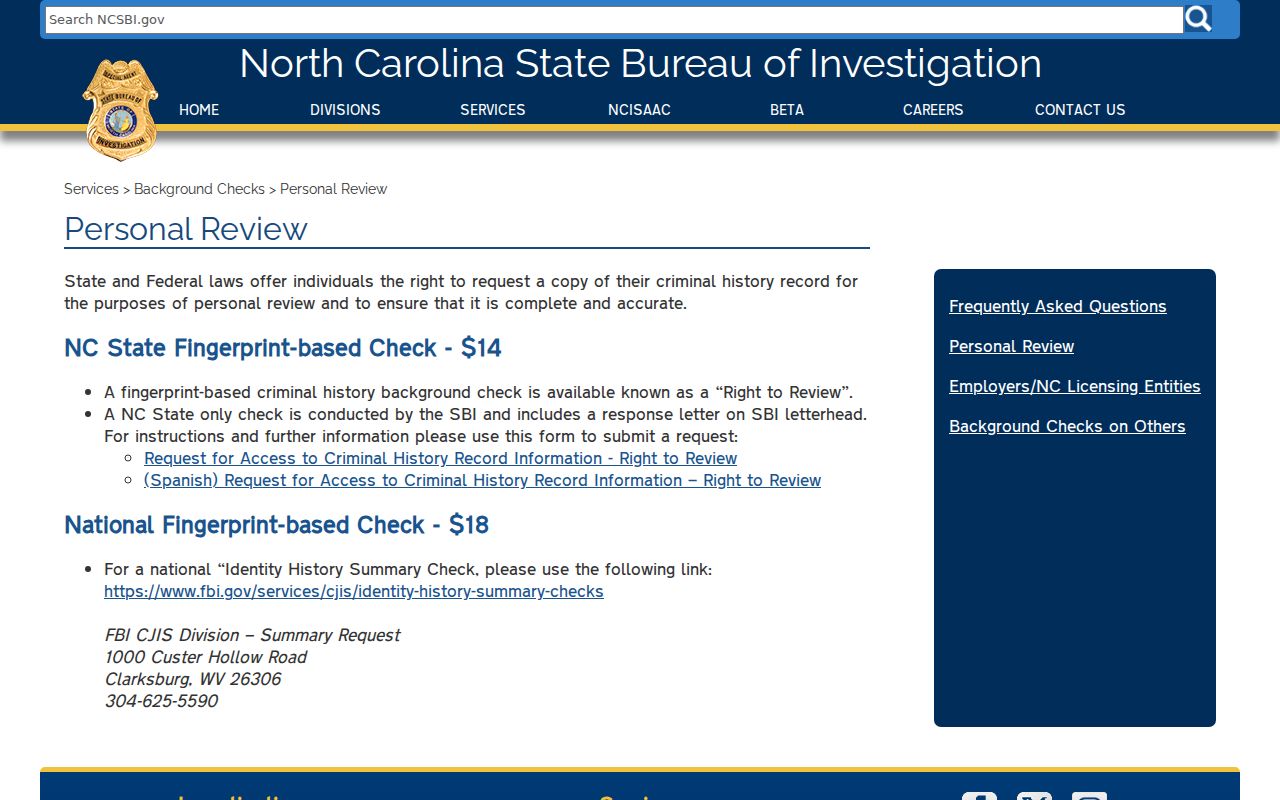
The source image helps distinguish SBI's subject-only fingerprint review from an open public name search or a certified Madison County court check.
- Arrest cycle
- A fingerprint-linked arrest entry and the disposition SBI later associates with it.
- Disposition
- The result of a charge, such as conviction, dismissal, or not guilty.
- Exception or challenge
- SBI's written process for disputing an item after reviewing your own record.
- Certified county search
- A clerk-issued name search limited to court records in Madison County.
Madison County Criminal Records by City
Madison County has exactly three incorporated towns: Mars Hill, Marshall, and Hot Springs. Each police department keeps the reports its officers create. None has a separate municipal court. Town ordinance and misdemeanor matters route to North Carolina District Court, while indicted felonies proceed in Superior Court. County booking records stay with the sheriff, and the court result appears through the Madison clerk or eCourts.
Mars Hill Criminal Records
Largest incorporated town; ask Mars Hill Police for town reports and the sheriff for county booking records.
Marshall Criminal Records
County seat; Marshall Police and the courthouse both use temporary public locations.
Hot Springs Criminal Records
Town police and sheriff work can overlap; cases still route through District 35 courts.
Madison County Correctional Record Searches
NCDAC Offender Public Information Search is the state follow-on channel after Madison County jail custody ends. It can show prison, probation, parole, post-release supervision, sentence, offense, admission, release, and absconder information where public. Probation is run by NCDAC Community Supervision, not by a separate county probation department. The Post-Release Supervision and Parole Commission makes the relevant parole and post-release decisions.
The NCDAC Offender Public Information Search is shown in the assigned capture.
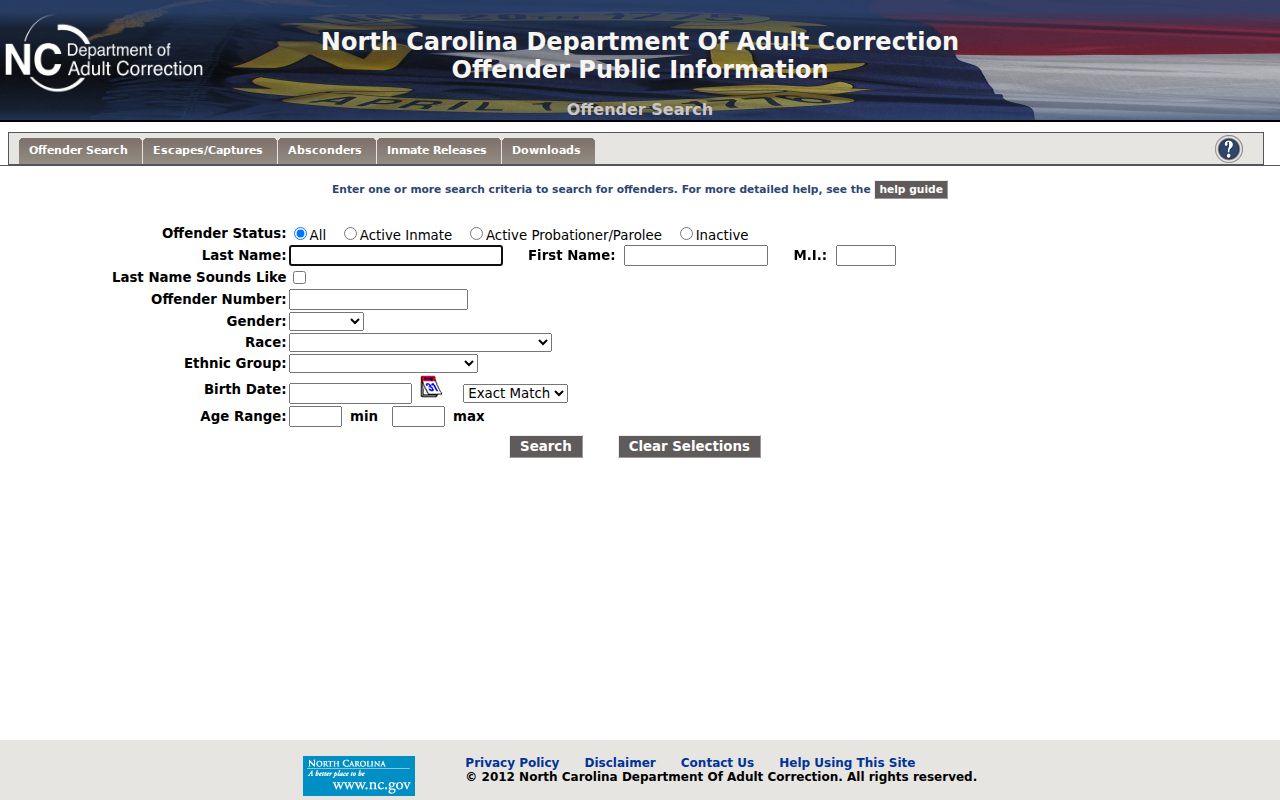
Use it for state correctional and supervision status, not as a substitute for current Madison County detention information.
The sequence is: local arrest, Madison booking, court disposition, then NCDAC custody or supervision when the sentence enters that system. The court record remains the source for the judgment, while NCDAC reflects the correctional status.
Federal Madison County Criminal Records
Federal cases are outside North Carolina eCourts. Madison County lies in the U.S. District Court for the Western District of North Carolina. PACER provides federal docket sheets and filed documents after registration, subject to its current usage and quarterly billing rules. The Western District website lists current court locations, calendars, and clerk contacts. Confirm the correct division before travel. The Western District of North Carolina court site is the official district source.
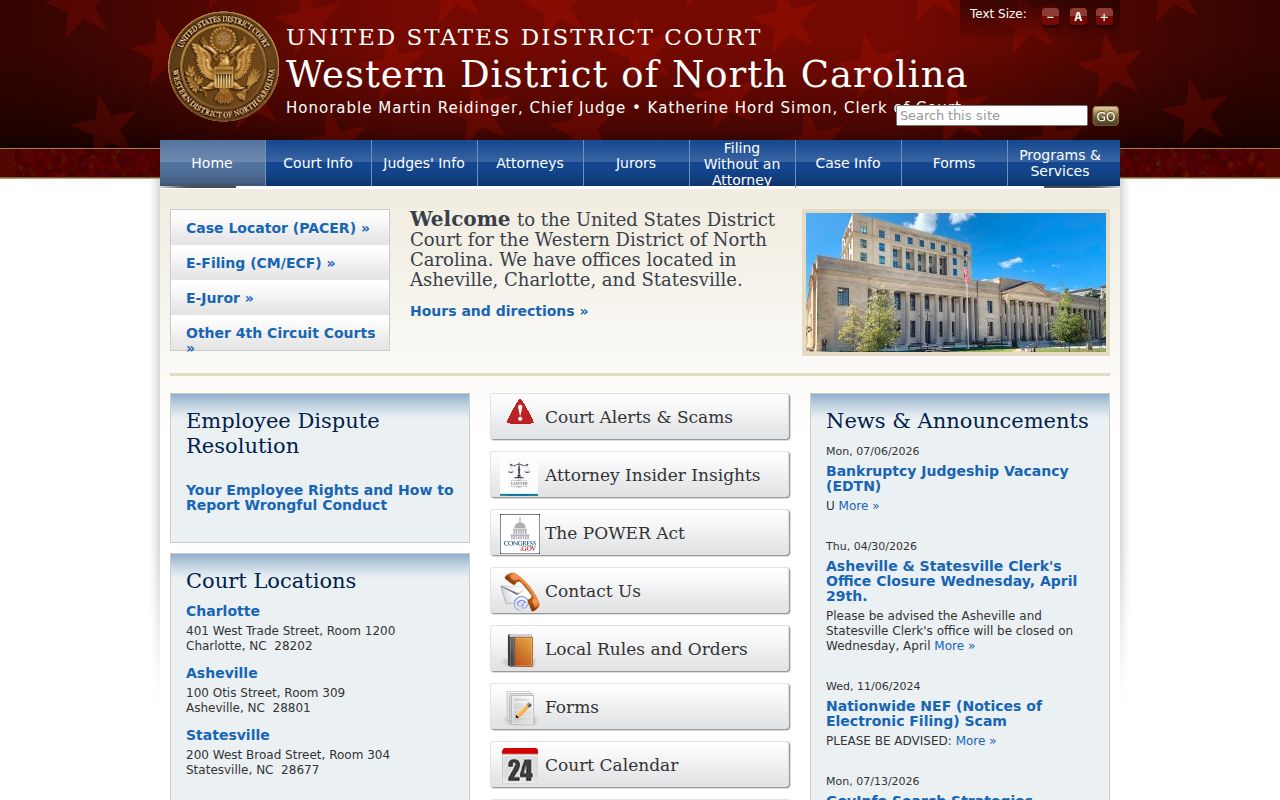
The federal court capture marks the separate path for a case that will never appear as a Madison County state docket. Federal incarceration uses another channel. The Federal Bureau of Prisons inmate locator searches federal custody records rather than Madison detention or NCDAC.
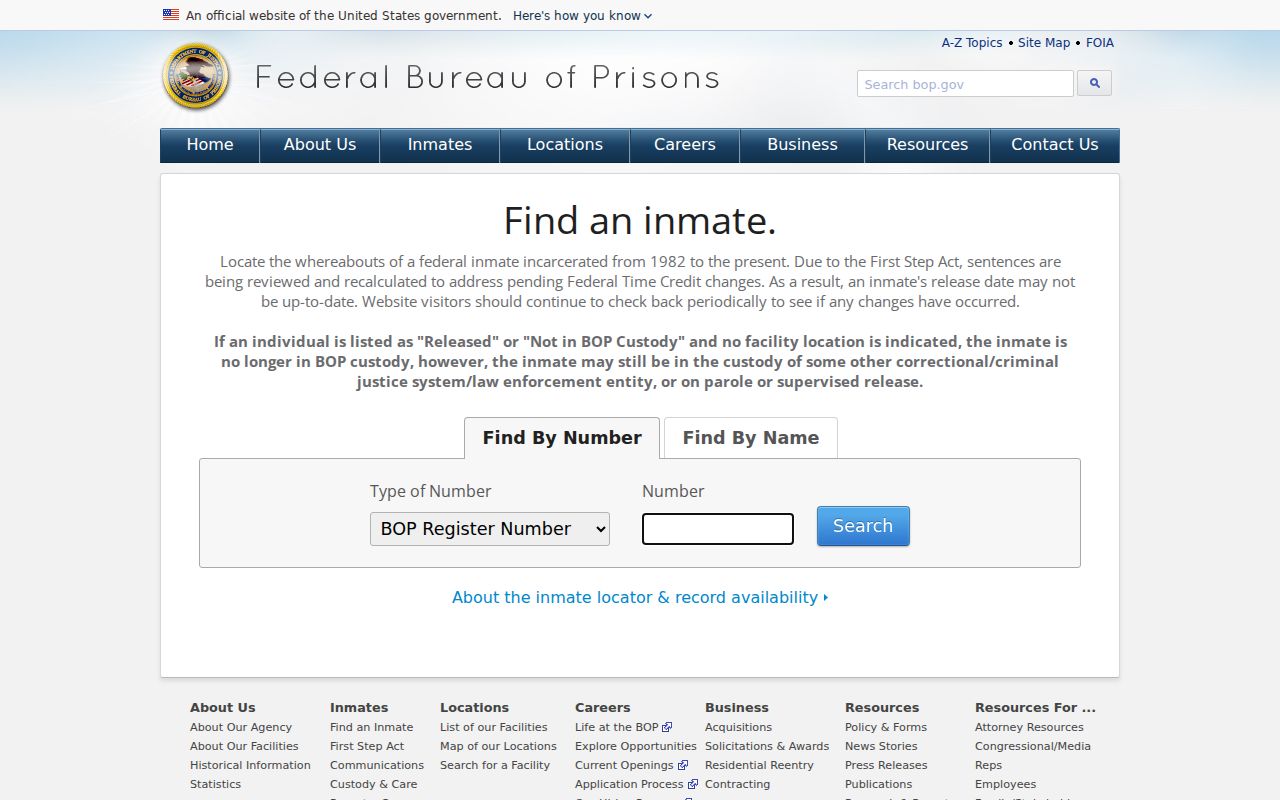
That locator belongs at the end of the federal chain, after confirming the matter is federal and the person entered Bureau of Prisons custody.
Note: A state eCourts search, NCDAC search, and federal PACER or BOP search cover different systems and should not be merged.